



Why a 10 TPH Feed Mill Switched to Tofu Cat Litter—and Signed for a Microwave Dryer On-Site
Recently, a customer who originally operated a 10 TPH animal feed production line visited our factory. Facing a sluggish feed market, the customer had decided to transition into tofu cat litter production. The customer planned to retain the existing extrusion equipment and was looking for a high-power, continuously stable microwave system to support the new line, together with reliable technical support.
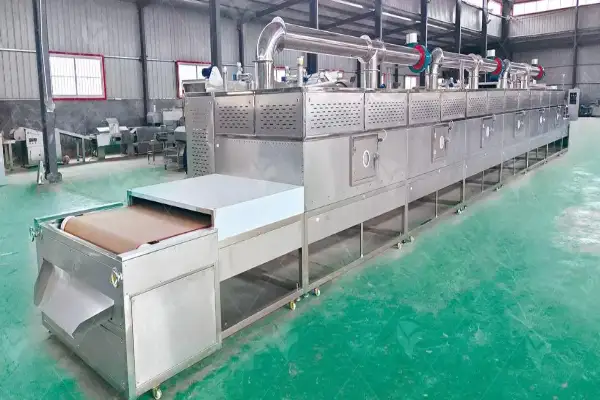
During the visit, the customer held in-depth discussions with our engineers and conducted on-site trials with tofu cat litter. Satisfied with the drying performance, the customer placed an order on the spot for a tunnel microwave drying machine. The customer also indicated interest in potential repeat orders for future capacity expansion.
About Microwave Drying Technology
Microwave drying is an internal, volumetric heating technology. Unlike conventional hot-air drying, which transfers heat from the outside inward, microwaves penetrate the cat litter granules directly. Water molecules inside the material vibrate rapidly under the high-frequency electromagnetic field and generate heat through friction. This heat is generated throughout the material and then moves outward, allowing moisture to evaporate efficiently. The process supports continuous in-line production and connects seamlessly with the upstream extruder used for tofu cat litter, so the dryer can be placed directly downstream of the extruder and matched to its output.
Key Advantages of Microwave Drying for Tofu Cat Litter
Fast drying and higher productivity
No lengthy preheating is required. Dehydration is completed in a short time inside the tunnel, and the drying speed can be matched to the continuous output of the extruder. This removes the bottleneck often caused by slow traditional hot-air drying and helps the line maintain a steady, continuous flow.
Drying and sterilization in a single pass, with low bacterial levels for pet safety
Sterilization takes place simultaneously with dehydration. The process effectively reduces bacteria, mold and spores in plant-based tofu cat litter. Because drying and microbial reduction occur in the same pass, the risk of recontamination during transfer between separate process steps can also be reduced. Lower microbial risks mean less chance of mildew during storage, creating healthier, safer litter for cats.
Uniform heating and consistent product quality
Heat develops from the inside out, which helps avoid common problems associated with traditional drying, such as burnt surfaces and wet cores. Finished cat litter has even moisture content, stable clumping performance and less dust, helping maintain consistent quality and a longer shelf life. This uniformity is particularly important for plant-based cat litter, where texture and clumping behavior directly affect customer acceptance.
Robust continuous operation and full technical support
This high-power industrial model is built for non-stop 24-hour operation and integrates with the customer’s existing production line. We provide complete after-sales service, including installation, commissioning, parameter tuning, operator training and maintenance, to help the customer transition smoothly from feed production to cat litter manufacturing. The support process is designed to reduce start-up risk and help the customer stabilize production quickly.
Intelligent and easy to control
The system is equipped with PLC control. Power, belt speed and temperature are adjustable, and production recipes can be saved for standardized manufacturing. Recipe storage also makes it easier to repeat successful settings across batches and shifts, supporting consistent production and simpler operator training.
Many feed manufacturers are shifting to tofu cat litter nowadays because their existing extruders can be reused. In this transition, drying and sterilization are critical processes that differentiate product quality. This microwave unit serves both drying and sanitation purposes, helping the customer launch premium, hygienic tofu cat litter and gain an edge in the pet market. For feed mills considering a similar move, an on-site trial is a practical way to confirm drying behavior, product texture and line compatibility before committing to equipment.